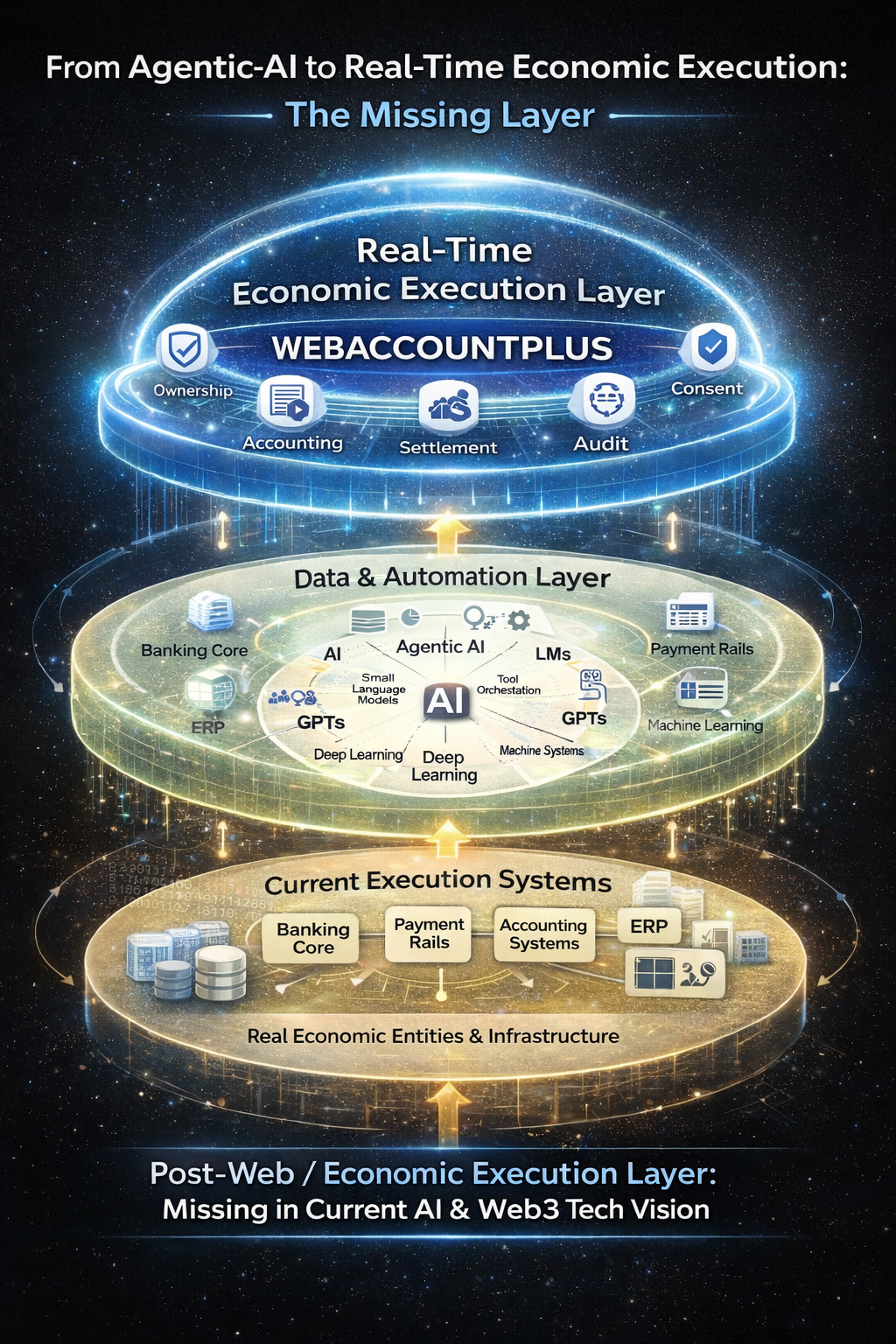
DIGITAL PUBLIC INFRASTRUCTURE (DPI) - EXECUTION LAYER
The missing execution layer required to operationalize UN, World Bank and multilateral economic frameworks in real time - and beyond. Fully patented and designed replicable for sovereign, global rollout
Real-Time Execution Layer
A Unified Approach to Economic Execution
This Real-Time Economic Execution Layer is designed to align with the existing frameworks set forth by the UN and World Bank. By integrating these established structures, this layer enhances economic operations through immediate execution, ensuring that consent, ownership, and accountability are inherently included in each transaction. It aims to streamline processes fairly and transparently, creating a system where all participants can trust the integrity of their interactions.
Systemic Consequences Across the Global Economy
A real-time economic execution layer does not optimize individual functions.
It restructures how capital markets, financial institutions, governments, and the real economy operate—by aligning execution, governance, and oversight within a single, continuous economic state.
Financial Market Infrastructure – L1

Capital Markets & Settlement
Today
Capital markets settlement is still governed by delayed cycles (T+1 / T+2), fragmented intermediaries, and multi-layer reconciliation between trading, clearing, settlement, and custody. Final ownership and cash movement occur after execution, creating counterparty risk, liquidity buffers, and operational overhead.
Execution Layer Impact
A real-time economic execution layer collapses trading, clearing, settlement, and reconciliation into a single atomic state transition. Ownership, cash, collateral, and entitlement are updated at the moment of execution, with immediate finality and no temporal gap between trade and settlement. Settlement is no longer a process—it becomes an intrinsic property of execution.
Regulatory Consequence
Real-time settlement reduces systemic risk, eliminates settlement exposure, and enables continuous supervisory visibility instead of retrospective reporting. Oversight shifts from post-event reconciliation to real-time state verification, improving market integrity, resilience, and transparency.
Structural Outcome
This transformation is not a product innovation or a market feature—it is the inevitable structural consequence of executing economic reality in real time.

Repo & Securities Lending
Today
Repo and securities lending markets operate through layered chains of intermediaries, delayed settlement, and rehypothecation cycles that depend on batch processing and end-of-day reconciliation. Collateral is reused across multiple links, creating opacity, timing mismatches, and systemic leverage that is only partially visible in real time.
Execution Layer Impact
A real-time economic execution layer converts repo and securities lending transactions into atomic, state-based events. Collateral ownership, usage rights, margin status, and maturity conditions are updated instantly at execution. Rehypothecation becomes an explicit, governed action rather than an implicit side effect of delayed settlement.
Regulatory Consequence
Real-time collateral state visibility eliminates hidden leverage and cascading settlement risk. Supervisory authorities can observe collateral chains, exposure concentrations, and maturity mismatches continuously instead of reconstructing them after the fact. Stress propagation is contained at the moment it emerges, not after it materializes.
Structural Outcome
Repo and securities lending cease to be chain-based processes and become real-time liquidity instruments with deterministic ownership, auditable collateral flows, and immediate enforceability. This fundamentally redefines how liquidity, leverage, and trust are structured in capital markets.

Derivatives & Margining
Today
Derivatives markets rely on batch-based valuation, delayed margin calls, fragmented collateral pools, and overnight risk exposure. Margining is typically calculated periodically, creating systemic gaps between market movement, exposure recognition, and collateral settlement. This introduces liquidity stress, procyclicality, and systemic risk during volatile market conditions.
Execution Layer Impact
A real-time economic execution layer converts derivatives from contract-based instruments into continuously executed positions. Valuation, exposure, margin requirements, and collateral adjustments occur in real time. Margin calls are no longer events—they become continuous execution states, enforced instantly as market conditions change.
Regulatory Consequence
Counterparty risk becomes observable and enforceable at execution level. Regulators gain real-time insight into leverage, exposure concentration, and systemic risk accumulation. Forced liquidations, margin spirals, and delayed interventions are structurally prevented through continuous execution and instant settlement.
Structural Outcome
Derivatives markets transition from periodic risk management to real-time economic control. Margining becomes dynamic, collateral becomes mobile and programmable, and systemic stability increases despite higher market velocity. This enables safer leverage, faster capital allocation, and fundamentally resilient derivatives markets.
Corporate & Institutional Finance – L2

Trade Finance (Letters of Credit, Guarantees, Export & Supply Chain Finance)
Today
Trade finance relies on document-heavy workflows, manual verification, fragmented bank coordination, and delayed risk resolution. Letters of Credit, guarantees, and export financing are processed through sequential checks, siloed systems, and jurisdiction-specific intermediaries, resulting in high costs, slow execution, and significant operational friction.
Execution Layer Impact
A real-time economic execution layer transforms trade finance from document-driven processes into state-driven execution. Commercial events—shipment, delivery, inspection, acceptance—are converted into verifiable execution states. Payment obligations, guarantees, and financing conditions are triggered automatically upon fulfillment, eliminating manual document reconciliation.
Regulatory Consequence
Compliance, sanctions screening, AML, and trade controls are enforced at execution level rather than retroactively. Regulators gain continuous visibility into trade flows, counterparty exposure, and jurisdictional risk without relying on post-event reporting. Fraud vectors linked to document duplication and delayed verification are structurally removed.
Structural Outcome
Trade finance evolves from paper-based trust into programmable economic execution. Letters of Credit become conditional execution contracts, guarantees become real-time risk commitments, and supply chain finance operates with instant enforceability. This enables faster trade flows, lower capital lock-up, and globally scalable trade infrastructure without increasing systemic risk.

Treasury & Liquidity Management
Today
Treasury and liquidity management are governed by fragmented cash pools, delayed visibility across accounts and jurisdictions, and forecast-based decision-making. Liquidity positions are reconciled periodically, while intraday exposures, trapped cash, and funding gaps are managed through buffers rather than real-time control.
Execution Layer Impact
A real-time economic execution layer transforms treasury from forecast-driven management into continuous liquidity execution. Cash positions, funding needs, collateral availability, and payment obligations are updated instantly across all entities, currencies, and accounts. Liquidity decisions are executed at state level, not approximated through projections.
Regulatory Consequence
Supervisors gain continuous visibility into systemic liquidity, intraday stress, and concentration risk across institutions and markets. Liquidity coverage, stress thresholds, and funding stability are enforced through execution logic rather than post-hoc reporting, reducing the need for emergency interventions.
Structural Outcome
Treasury evolves from a control function into a real-time economic nervous system. Liquidity becomes a managed state, not a reported metric, enabling capital efficiency, faster response to stress, and structurally resilient financial institutions without increasing regulatory burden.

Cross-Border Payments & FX
Today
Cross-border payments and foreign exchange settlement are characterized by correspondent banking chains, pre-funded nostro/vostro accounts, time-zone delays, and fragmented liquidity pools. FX execution, settlement, and reconciliation occur across separate systems, introducing latency, cost, and settlement risk.
Execution Layer Impact
A real-time economic execution layer collapses cross-border payments and FX into a single execution state. Currency conversion, payment settlement, and ownership transfer occur atomically at execution, without pre-funding or intermediary reconciliation. Liquidity is mobilized dynamically across jurisdictions rather than trapped in static accounts.
Regulatory Consequence
Supervisory authorities gain real-time visibility into cross-border flows, FX exposure, and jurisdictional risk. AML, sanctions, and capital controls are enforced at execution level instead of after settlement, improving compliance effectiveness while reducing operational friction.
Structural Outcome
Cross-border payments transition from correspondent-based processing to direct economic execution. FX becomes an embedded execution function rather than a standalone market, enabling faster settlement, lower systemic risk, and globally scalable payment infrastructure without increasing regulatory complexity.

Collateral Management (Cross-Asset, Cross-Border)
Today
Collateral management operates across fragmented asset classes, jurisdictions, custodians, and valuation frameworks. Collateral eligibility, valuation, reuse, and substitution are processed with delays, manual controls, and limited transparency, leading to inefficient capital usage and hidden systemic dependencies.
Execution Layer Impact
A real-time economic execution layer transforms collateral into a continuously governed execution state. Assets across cash, securities, commodities, and tokenized instruments are valued, allocated, substituted, and released in real time. Collateral mobility becomes intrinsic to execution, not an operational afterthought.
Regulatory Consequence
Supervisors obtain continuous visibility into collateral concentration, reuse chains, and cross-border exposure. Eligibility rules, haircuts, and concentration limits are enforced directly at execution level, preventing excessive leverage and opaque collateral cascades before systemic stress emerges.
Structural Outcome
Collateral ceases to be a static buffer and becomes an actively managed, programmable economic resource. Capital efficiency increases while systemic fragility decreases, enabling resilient markets with lower collateral requirements and higher transparency across asset classes and jurisdictions.
Monetary & Public Systems – L3

Central Banking & Monetary Policy Transmission
Today
Central banks rely on indirect transmission mechanisms, delayed indicators, and aggregated reporting to steer monetary policy. Interest rates, liquidity facilities, and regulatory instruments are applied with temporal gaps between policy decision, market reaction, and real-economy impact.
Execution Layer Impact
A real-time economic execution layer enables direct, state-based monetary transmission. Policy signals, liquidity conditions, and eligibility rules are embedded into economic execution itself, allowing monetary intent to propagate instantly across financial markets, institutions, and the real economy. Monetary policy shifts from influence to execution.
Regulatory Consequence
Central banks gain continuous, real-time visibility into liquidity flows, credit propagation, and systemic responses to policy actions. Macroprudential controls, stress thresholds, and intervention mechanisms operate through execution logic rather than delayed observation, increasing effectiveness and reducing unintended spillovers.
Structural Outcome
Monetary policy evolves from reactive steering to real-time economic governance. Central banks operate on live economic states instead of historical aggregates, enabling precise, proportional, and auditable policy execution across the financial system without increasing institutional complexity.

Public Finance, Subsidies & Government Execution
Today
Public finance operates through budget cycles, delayed disbursement, fragmented agency systems, and ex-post auditing. Subsidies, grants, tax incentives, and public spending are administered through manual processes, siloed data, and retrospective controls, resulting in inefficiency, leakage, and limited real-time accountability.
Execution Layer Impact
A real-time economic execution layer converts public finance from budget-based allocation into state-based execution. Subsidies, grants, tax credits, and public payments are issued as conditional execution states, released automatically upon verified economic events. Public spending becomes programmable, auditable, and aligned with real economic activity at the moment it occurs.
Regulatory Consequence
Governments gain continuous visibility into public fund allocation, utilization, and impact. Misuse, duplication, and delay are structurally prevented through execution-level controls rather than post-event audits. Fiscal policy enforcement becomes precise, proportional, and immediately traceable.
Structural Outcome
Public finance transitions from administrative distribution to real-time economic governance. Subsidies and incentives operate as execution logic instead of discretionary programs, enabling higher efficiency, stronger accountability, and measurable policy outcomes without expanding bureaucratic complexity.
Real Economy & Impact – L4

Global Trade, Commodities & Infrastructure
(Trade, Commodities, Logistics, Infrastructure Finance)
Today
Global trade, commodities, and infrastructure finance operate across fragmented legal, financial, and logistical systems. Trade finance, shipping, customs, commodity settlement, insurance, and infrastructure funding are coordinated through delayed documentation, manual reconciliation, and siloed intermediaries. Settlement cycles, counterparty risk, and opacity dominate cross-border economic flows.
Execution Layer Impact
A real-time economic execution layer synchronizes trade flows, commodity ownership, logistics events, financing, insurance, and settlement into a unified execution state. Goods movement, title transfer, collateralization, payment, and risk coverage are executed atomically as a single economic event. Trade is no longer documented after delivery — it is executed as it happens.
Regulatory Consequence
Customs authorities, trade regulators, and financial supervisors gain real-time visibility into cross-border flows, commodity positions, sanctions compliance, and infrastructure exposure. Trade compliance, tariffs, export controls, and risk limits are enforced through execution logic rather than ex-post audits, reducing fraud while accelerating legitimate trade.
Structural Outcome
Global trade transitions from document-driven coordination to execution-driven trust. Commodities become instantly financeable, infrastructure projects gain real-time capital access based on verified progress, and cross-border commerce operates with reduced friction, lower risk, and deterministic settlement. Trade becomes scalable, transparent, and governable at global scale.

Real Economy Execution (SMEs, Supply Chains, Energy, ESG)
Today
The real economy is managed through disconnected systems for finance, operations, logistics, energy, and compliance. SMEs, supply chains, and infrastructure operators rely on delayed reporting, manual coordination, and fragmented oversight, limiting visibility, access to capital, and effective policy execution.
Execution Layer Impact
A real-time economic execution layer integrates financial, operational, and physical economic activity into a single execution framework. Production, delivery, consumption, energy usage, emissions, and payment are reflected as synchronized execution states. Economic reality is captured and acted upon as it occurs, not reconstructed after the fact.
Regulatory Consequence
Regulators and institutions gain real-time insight into economic activity, ESG impact, energy flows, and supply chain resilience. Compliance, incentives, and sustainability targets are enforced through execution logic instead of static reporting, enabling measurable outcomes without additional administrative burden.
Structural Outcome
The real economy becomes directly executable, governable, and financeable in real time. SMEs gain immediate access to liquidity based on actual performance, supply chains operate with verifiable trust, and sustainability transitions from reporting obligation to executable economic behavior.

ESG, Carbon & Impact Marktets
ESG and carbon markets today suffer from fragmented standards, delayed verification, and trust deficits between issuers, regulators, and investors. Reporting is largely retrospective and disconnected from actual economic activity.
The Real-Time Economic Execution Layer enables ESG commitments, carbon credits, and impact metrics to be embedded directly into transactions, supply chains, and financing flows.
Impact is no longer reported after the fact — it is executed, measured, and auditable in real time, creating a verifiable link between capital allocation and real-world outcomes.

Why This Cannot Be Built Incrementally
The Real-Time Economic Execution Layer cannot be achieved through incremental upgrades of existing banking, payment, or market infrastructures.
Current systems are fundamentally built around delayed settlement, fragmented data ownership, and post-factum reconciliation. Adding APIs, AI, or automation layers on top of these architectures only accelerates broken processes instead of eliminating them.
True real-time execution requires ownership, consent, accounting, settlement, and auditability to be resolved at the moment of action, not hours or days later. This demands a unified execution fabric designed from first principles — not a patchwork of interoperating legacy systems.
Any attempt to build this incrementally would preserve latency, counterparty risk, and structural opacity. The execution layer therefore must be architected as a new foundational layer, not as an extension of the old one.